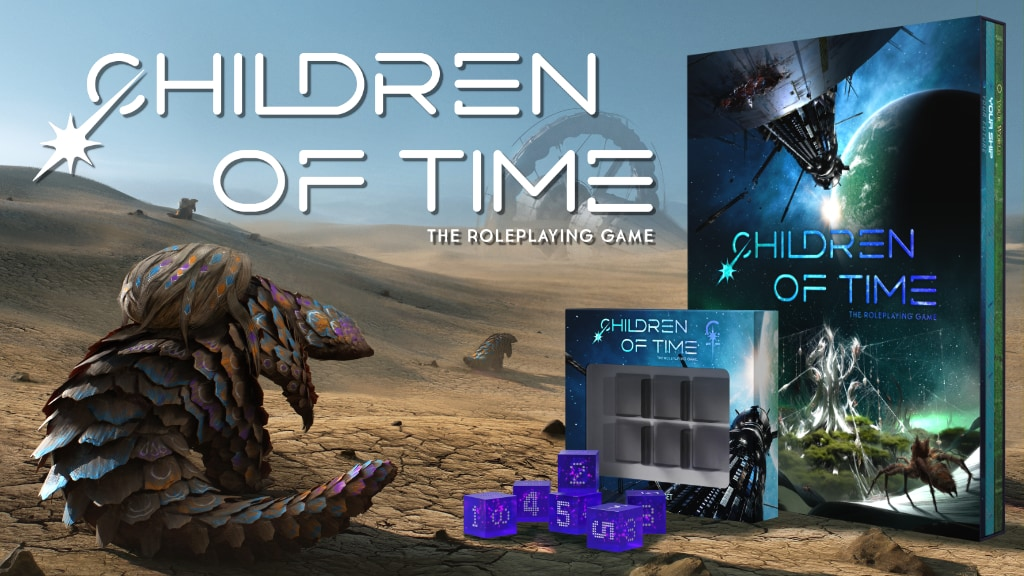
Create millennia-spanning sci-fi epics in this groundbreaking roleplaying game based on the award winning Children of Time novels.
Latest Updates from Our Project:
Children of Time design diary 3: All Gods, No Masters
3 months ago
– Fri, Aug 07, 2026 at 07:19:17 AM
Hey all!
We're in the final stretch, now. Thanks again for all your help making this collective venture the best success it can be! Crowdfunding is a collaboration between the publisher and the audience, and game design is a collaboration between the designer and each individual play group. So it’s only right, I think, that today I’ll talk about how this game is all about collaborative storytelling.
Looting the GM’s Body
Here’s the thing about game masters: they’re a great tool, but every tool has its specific uses. When you’re coming to the table to play a character and respond to a challenging situation, a GM is really useful. But with a game like this – a game of asking interesting questions and building on each other’s answers – a traditional GM role didn’t make sense. Instead, I’m doing something different.
There’s no single GM in Children of Time, but it’d be a mistake to call it GM-less. Instead, I’ve taken the GM role, disassembled it into its component pieces, and sharpened each of those pieces into a specific tool – custom-designed to help groups tell the stories this game is designed to support.
Let’s talk about those pieces. In a traditional RPG, the player taking the GM role might do any or all of these things:
Be an expert on the game’s rules and decide how they apply to a particular situation.
Give voice to the NPCs the characters encounter.
Create mood, build atmosphere and control pacing.
Describe challenging situations that prompt characters to take action.
Manage plot and character arcs and try to make them resolve satisfyingly.
Describe the world in ways that are consistent and compelling.
Manage the out-of-character organization: scheduling, snacks, resolve personality conflicts, etc.
With the exception of the last one, all of those are still present in Children of Time – but they’ve found a new shape as Play Stances.
Play stances stay with you whether you're in the ark or on the planet.
Each play stance is a tight bundle of things their holder should pay attention to, questions they can ask, and levers they can pull to alter the flow of the game. The game presents six of them:
The Viewpoint, guiding a specific character through the world.
The World (AKA the Ark or Planet), describing the wonders and hazards the character encounters.
The Crowd, playing the supporting cast of the story and voicing their demands.
The Doom, keeping things tense and dangerous.
The Guide, facilitating play and helping the group work through the rules.
The Historian, pushing the table towards interesting stories and lasting legacies.
Sometimes no-one will be holding a stance; sometimes multiple people will be sharing one. A tense exploration of the ark’s guts might have one Viewpoint player, with everyone else being World or Doom; one the other hand, a negotiation between two factions might have two Viewpoints, two Crowds, and one Historian.
What’s in a play stance?
Just like your characters and cohorts, play stances are held communally. Just like their main inspiration – the setting elements in Dream Askew – they each have guidance on when you pick them up, and when you put them down.
But there’s more to them than that. Each one also has:
An agenda that you’re trying to hit for as long as you’re holding one.
An ending move that gives you a particular way to keep the story moving.
Fallouts you’re encouraged to push for when a character triggers one.
The last one is particularly important! The books are full of ideas for fallout that might happen when a roll goes badly for a character. Each one reverberates out into your narrative, whether they’re applied to a character, a group of people, or the world your characters are exploring. Each play stance has a particular theme to the fallouts linked to it:
The Viewpoint stance gives fallouts that hurt the character you’re playing – make them exhausted, injured, exiled, lost entirely.
The World stance gives fallouts that change the environment for the worse – seal off travel, throw locations into chaos, create terrible calamities across the map.
The Crowd stance gives fallouts that upset the broader populace – characters piss them off, they make demands, they schism off, grudges turn to violence.
The Doom stance is deeply tied to the current crisis, and so all of its specific fallouts are Doom fallouts! Aside from that, Doom can ruin gear, make situations more dire, and outright destroy locations.
The Historian gives the long view. Their fallouts forecast future troubles, shift how moments will be remembered, and reveal unseen issues and hidden identities.
Finally, the Guide sits back from the fallout discussion – they don’t have any of their own, but instead act as an arbiter and referee as the group works out how things go wrong.
Your character can suffer many awful things, if you so wish.
Pushes and Permissions
Here’s the thing about games without a single GM – their rules need to place more structure on your storytelling than traditional games, not less. Restrictions are the source of creativity, after all. All of the play stance rules I’ve described here are ways to get focused on the questions that most interest you – taking the horrors of a blank page and giving you lines to color within.
In a recent conversation with Jay Dragon (which you can find on the RRD blog!) we talked about the challenges of writing group storytelling games. One of the things she mentioned was how hard it is to get people to cause problems for each other! In our day-to-day lives we don’t want to make other folks’ lives harder, right? But if you’re telling a story, you want conflict. You want friction, you want hardship, you want the unexpected.
That’s why play stances are framed the way they are. To play this game – especially in the high-stakes zoomed-in Viewpoint phase – you need to pick up a play stance and push its agenda. Everyone’s making an intentional choice to complicate the story in some kind of way, but also no-one has the sole duty of making life harder for the others. Even the person playing your current main character has levers to pull if they want that character to face trials. Each play stance is a set of pushes and permissions – ways it encourages you to act, and problems you have your group’s support in introducing. And if you get tired of viewing the story through that lens, simply put the play stance down. Take a beat to watch the story unfold, maybe offer suggestions and advice to the other players, maybe pick up a new stance. It’s jazz, a dance, a flowing and wild thing. It’s play.
Zooming Out
Play stances are most present in viewpoint scenes, but they have a role in the other phases too. In the scheme phase, for example, each stance has a chance to describe how your background characters have spent their time offscreen. And in speculation, where no-one’s holding any particular stances, they instead serve as reminders of what things you might wish to speculate about. When you ask a question, or answer one posed by another player, think about what the play stances would encourage you to say. Think about what stories you want to tell. Think about what stance you’d like to pick up next.
Relaxing the Stance
So: that’s the basics of how you play Children of Time RPG. To me, it’s honestly very similar to standard game’s responsibilities and flow – just disassembled, redistributed, given more guidance and intention.
There’s ten days left in the campaign! Which means two more blogs to write, I think. What would you like to hear about next? How characters grow, change, and recur from era to era? Or how I’ve fused Blades in the Dark, the Resistance Engine, and my favorite storytelling games into the actual taking-action-and-rolling dice mechanics?
Stay weird and keep evolving!
Minærva
Announcing the Children of Time RPG Solo Mode!
3 months ago
– Tue, Aug 04, 2026 at 08:53:11 AM
You asked for it and we listened! We’re happy to announce that as we enter the final week of the Kickstarter campaign, we’re adding a whole new book to the campaign: stand alone solo mode of the Children of time RPG.
Some quick fire points so you know what this means for you.
The Solo Mode is a standalone book that contains everything you need to play the game by yourself, including full rules, crises, and prompts all adjusted for a solo play experience. You won’t need to buy the corebook set to play solo (though the Time Capsule is still a great accessory!)
The book is designed to sit alongside the Children of Time novels, so expect a trade paperback with a simpler layout, largely black and white interiors, and a section of gorgeous colour plates.
You can add a physical or digital copy of the solo mode to your pledge as an add-on, or if you’re a new backer, we’ve also added a new Solo Mode only pledge level as well. The physical version costs £16 while the digital version costs £8.
IMPORTANT: All backers of the I Want Everything physical and digital pledge levels will receive a physical or digital copy of the solo mode for free! So those bundles give you even greater value now!
If you’re hungry for more details, you’re in luck! We’ve dragged Chant Evans into the team to spearhead the writing and design of this one, and he’s kindly provided us with a rundown of what you can expect.
A Word From Chant
Hello, everyone!
I’m Chant, one of your diligent book janitors (“producers”, supposedly) here at RRD, and I’m making the solo version of the Children of Time RPG. It’s not my first rodeo: the first roleplaying game I ever designed was Final Girl, a Wretched & Alone hack that riffed on slasher movies. (Yes, I named it before the board game, thank you very much. My SEO is screwed now.) I’ve kept on making solo games ever since. I’m on four published now, with more in the works.
I’ve worked at Rowan, Rook & Decard for two and a half years now, and I’ve seen a lot of crowdfunders happen. Every time, someone - usually a significant number of someones - asks us whether we’re going to make a solo mode for this game/supplement/other. So far, the answer’s always been “absolutely not, under no circumstances, we are making so many books already. How will we feed all these books?”, but with Children of Time, that has changed.
We’re doing it, gang. We’re making a solo game.
Children of Time: The Roleplaying Game: Solo Mode (working title) is:
A completely standalone book that you can use without cracking open the core game books
A reversioning of what Minærva has crafted for the core books, taking the ark and the planet, plus all of the crises, cohorts, and other essential elements, and reframing them for solo play
Slightly simplified mechanics, so that there’s still a random element/chance of failure but more focus on your story and how you want to tell it
Very rarely does the whole team agree on a design-related question, but when we first looked at the possibility of solo mode, it was immediately clear to all of us (Maz, Minærva, Elaine, and I) that Minærva’s work was already excitingly close to being playable solo.
The way Children of Time is structured is a gift for solo play. It moves elegantly between zoomed in play - focused on specific characters and moment-by-moment action, in Viewpoint scenes - and zoomed out - wider, bird’s eye view in Speculation and Schemes. Each chapter builds directly off the last, and as the players have so much narrative authority, they’re already directly creating the story, rather than reacting to a traditional GM.
Solo mode, then, just needed two things:
A way to help a single player’s brain come up with as many ideas for storylines, twists, and developments as an entire group can
A way to structure play that makes it easy to juggle all those plotlines and characters, that you can compress into a notebook or a digital document
We’ll still have the Speculation-Viewpoint-Schemes loop that makes the ongoing narrative so easy to develop. We’ll still have D6-based resolution. We’ll still have a range of Crises for characters, locations, and cohorts to reckon with. We’ll just work through them slightly differently.
The most immediate and obvious change is that, where Minærva’s group game uses four different Viewpoint stances - Doom, the World, the Crowd, the Historian - in addition to the viewpoint character, solo mode focuses exclusively on the viewpoint character. The other play stances are still there, but they operate as ways to determine the fallout your actions bring about.
The next big change is how we use random elements. In the core game, you’ll use them to resolve actions, just like you would in most group roleplaying games. Here, you’ll use D6s to generate prompts to push your narrative forward and your character/characters to react to. You’ll roll on spark tables to determine what’s been happening since the last viewpoint scene, decide who’s involved in the current one and what they want, and whenever there’s an opportunity for the narrative to do something interesting. The intention is to take some of the pressure off: if you have a clear idea for what happens next, you can always use it. But you’ll never, ever be stuck on writer’s block.
(Now. A lot of those spark tables come directly from Minærva’s existing or planned work on the group game. I’m just tweaking them a bit. Credit where it’s due.)
You’ll also use dice to determine how well a viewpoint character pulls off their planned course of action. At the end of a viewpoint scene, you’ll make one dice roll. The closer the character stuck to their strengths, the better their likely modifier. But frankly, rolling badly is more fun, because fallout - the consequences of your actions - is fun, and bad rolls equal more dangerous fallout.
Oh - there’s one more big change that, if you play many solo games, you probably already assumed would be there. I am very, very interested in the output of solo roleplaying. When you play with a group, the output’s your shared experience and the memory of the session. Alone, I like to have something physical to look back on. So in Children of Time: Solo Mode, you’ll be writing. Your viewpoint scenes will become short stories and your speculation and schemes will become zoomed out passages of writing about what else is happening. (You know, just like Adrian does in the books). How much you write is up to you, of course - some people love knocking out a five-thousand word short story over a weekend, some just want some notes and key moments and both are extremely valid.
The point is, you’ll have something you can proudly look back on and say “I wrote that.”
- Chant
Stretch Goal Unlocked: Slipcase Upgrades
4 months ago
– Wed, Jul 29, 2026 at 09:28:40 AM
We've hit our next stretch goal! And only 30mins before we have our fireside chat with Adrian and Mina over on the RRD discord too. (Join us over here to celebrate!)
The book sicko in my heart erupts with excitement to announce that we’ve officially hit our £100,000 stretch goal! Now we get to upgrade all the corebook sets with a fancy viewport, greyboard construction, and a gorgeous printed liner. All these upgrades are going to make the corebook feel even better. We can’t wait to get it into your hands.
And speaking of upgrades, we’re not stopping here! Next up on our journey is our second content pack! This time the theme is Plague, and just like the Stowaways did with the ship book, the Plague content pack will add new crises and cohort content, but this time to the planet book.
We’ve also revealed the next stretch goal after the Plague content pack will be some upgrades to the Time Capsule. We’ll talk more about them as we approach, but you can be certain that we’re hype to continue improving the stuff you’re spending your hard earned money on.
Until next time,
Stay curious.
Elaine & The RRD Team
Children of Time RPG Dev Diary 2: Focuses
4 months ago
– Sat, Jul 25, 2026 at 08:16:47 AM
Hey all! Thanks to everyone who’s joined the campaign since the last design diary. In that one, I discussed how speculation is the core unit of the game – you and your friends thinking up an interesting situation, and asking each other questions about what’ll happen next.
Getting Focused
Today, I’d like to talk about the places that you’ll be telling stories about. In the game, I call these the different focuses of your story. There’s three of them, one for each book in the corebook set:
The terraformers of the old empire of Earth, working miracles just before its collapse.
The planet the terraformers were shaping, and the new life that grew on there after their fall.
The ark the old empire’s descendants built to escape Earth, seeking the paradise world spoken of in legend.
Your campaign jumps from focus to focus, gradually braiding them together.
You play this game chapter-by-chapter. Each chapter, you pick your focus and the crisis they’re facing. This, too, is a storytelling decision! Say your group just played through the ark’s response to a manpower crisis – they’ve taken enough casualties they’re not sure they have the skills to hold the ark together over the remaining millennia of travel, so what do they do about it?
Whatever the results, your group must choose where they want to focus for the next crisis. Maybe they stick with the ark and have the tensions boil over into a mutiny crisis; maybe they instead shift over to the planet, and show how the uplifted animals deal with having too many people now as they face the expansion crisis.
Two of the crises from the Ark focus of play.
In this way, your group has the power to decide the topics and themes their campaign covers – the similarities and differences between the societies at play, and the influence of the precursors who came before them.
The game’s core rules stay the same between focuses: you’re still playing characters trying to pursue their personal goals using the strengths inherited from their social cohort, picking up and putting down play stances as suits the story. But each focus also adds its own wrinkles, to give chapters set within their own texture and feel at the table.
Let’s go focus by focus and show how that works!
The Terraformer Focus
The Terraformer focus acts as a prologue and tutorial for the rest of the game – teaching you the rules and setting up the stakes for the rest of the campaign.
In this focus, you play the old empire’s most prestigious scientists and engineers, but the real star is the planet. When you play as terraformers, you work an incredible miracle – turning a halfway-decent lump of rock into somewhere humanity can actually thrive. As you play, you define the planet. You set up the core traits that brought you here, deploy technology to fix its flaws and magnify its strengths, and debate about what kind of paradise it will become.
As you pick traits from each of these six categories, your planet takes shape.
You’re angels playing in eden, but there’s a snake in the grass. The interstellar empire that paid for this project is collapsing, and that collapse is sped by a virus that’s already dormant in your station’s systems. What can you accomplish before the virus destroys everything you need to survive? And what will remain of you, to be found by those peoples that come after? These are the big questions of the Terraformer focus. Even when you move on to the ark or the planet, the things you establish as terraformers will stay important and relevant.
The Ark Focus
The old empire may have fallen, but humanity survived. Earth is poisoned and war-scarred, but some of the technological marvels of the pre-collapse society are still here. From scavenged parts and archived data, the ark project was born – dozens of colossal ships filled with frozen humans in their thousands, sent out into the depths of space in search of one of those near-Earths found in the archives of the ancient terraformers.
Each ark ship will deviate significantly from the shared blueprint.
In the ark focus, you play the crew of one of those arks, frozen in cryo tubes and thawed out when a problem needs your specific set of skills. You start by building and naming your particular ark – its key locations, and the special components that set this particular ship apart. Maybe it has a self-aware AI managing it, luxury quarters salvaged from old empire cruise liners, or hydroponic farms ready to produce fresh food.
Then you talk about its crew. The Ark Project picked each of you, and put you into particular departments: Key Crew, Engineering, Scientists, and Security. You talk about how your crew is defined – how do people expect Security to act? What do Key Crew tend to wear? How do others treat the Scientists who wake them up from cryo?
The Ark Ship Hammurabi, from one of our playtests.
And then, finally, you put the ship in flight. This is a game of entropy and evolution, and the ship skews heavily to the entropy side. Your survival depends on you keeping its various systems out of the red – Key Crew need make sure it’s on course to reach its destination, Engineering slow the rate its systems are failing, Scientists manage population health and safely bring people in and out of cryo, and Security throw bodies at problems and attempt to manage discontent among the crew. Each of those comes with their own fallouts that persist from chapter to chapter, showing the impact of your character’s actions even when they might be lost to the ark’s depths or fail to wake up from cryo.
If your scientists are doing their job right, it's very likely your time in cryo will be painless and easy. Unfortunately, scientists are fallible people too.
If you manage to beat the odds and hold your ark ship together, you might just reach the terraformed planet paradise the old empire’s records promised you. However, those records are ancient, incomplete, and full of corporate propaganda.
What really happened to the terraformed world in the tens of thousands of years since the terraformers died?
The Planet Focus
While the terraformers are long dead – barring any desperate experimental mind uploads – their beloved planet sticks around. Unshackled from their overbearing would-be-gods, but bearing the blessings of their victories and the scars of their failures, it’s become the home of a new society of creatures – Earth life, uplifted to sentience by a nanotech virus gone rogue in the terraformer’s absence. It’s those creatures that this focus is all about.
Here's how I'd define the interesting traits of our uplifted pangolins – maybe your group would pick different?
Step one of the planet focus is working out what kind of animal you’re playing. I encourage groups to treat this like a powerpoint party – bring your own pitch for an interesting creature, talk about what excites you about them, share weird animal facts, and listen to other people’s suggestions. The book has guidance for this discussion, and how to ask each other interesting questions – but passion is the key thing! By the end of the process, you’ll find your creature, know their strengths, and the problems they’re likely to face as their society evolves.
Once you’ve got your creatures, it’s time to decide how they socialise. The book gives five different social cohorts, of which you’ll pick three to begin with. Maybe your inquisitive spiders have Builders, Lorekeepers and Pioneers? Or perhaps you’re playing a mixed group of cetaceans – and so most of your Lorekeepers are blue whales, most of your Warriors are orcas, and Steward porpoises try to hold it all together? Whichever you pick, you customize these cohorts like the ones on the ark: you decide how others see them, how they tend to approach problems, and take the first steps in defining their impact on the world.
The Warrior cohort are defined by violence, and themselves get to define who society views as valid victims.
If the ark ship focus leans towards entropy, the planet focus is about evolution. You’ve got this vast possibility space to explore – an unmapped planet, a nascent society, a history as yet unwritten. The planet’s systems aid in this: they give rules for exploring this world, learning more about its seasons, and changing society in permanent ways. Even the roles your characters play in society (and their accompanying abilities) change over time, as veterans shift to become trained leaders and wretches become failures kept from rock bottom by a social safety net.
It's a big world out there – what will you discover?
Shifting Focus
That’s the big idea behind the arc of the game, and why we’re making three books instead of one. It’s not just a game about society-building but also comparative society-building, and that’s really exciting to me.
Next time… hmm, I think I’ll let you folks decide what I talk about next week. Which of these do you most want to hear about?
How characters stand out from their society and change the world.
How individual actions ripple out into society-wide fallout.
Why the game excels at GM-free (or rather, GM-full) gameplay.
Children of Time RPG Week 1 Roundup
4 months ago
– Wed, Jul 22, 2026 at 04:14:34 AM
It’s been a great first week of the Children of Time RPG crowdfunding campaign, so we thought we’d compile all the highlights together into one place for folk who might have missed some of the details, as well as announce some upcoming events. Let’s dive right into it!
Funding and Stretch Goals
It’s only been a week but we already hit our funding goal and launched our ark ship to begin the long journey to unlock additional stretch goals.
This week we unlocked:
A new short story called ‘The Scent of Distance’, written by Adrian Tchaikovsky himself, that’ll be added to the Children of Time RPG Quickstart. It features a dangerous investigation into the fate of a Pangolin religious poet, whose most recent work threatens to upend everything Pangolin society knows about their place in the universe.
A content pack focusing on ‘Stowaways’ will be added to the Your Ship book, featuring a new crisis, cohort and rules for the ark ship discovering a failing planet home to uplifted creatures – and the process by which those creatures become ark crew.
We’ve more stretch goals to unlock, and even more yet to be revealed, so keep your eyes peeled and shout about the campaign so we can keep adding to the books.
We're Talking About Design
We've been excavating design secrets from Mina's brain. Read them here, and find out why we're so revoltingly proud of Children of Time.
Mina put together the first of a series of design blogs as a Kickstarter update. In which Mina talks in depth about what makes Children of Time such a great series to turn into a roleplaying game, and gets into the nuts and bolts of how the Speculation phase works at the table.
Mina and Adrian were also interviewed by Rascal Games before the campaign and provided some keen insights into how the game came to be and the philosophy behind it. Read it on Rascal News.
And there’s more to come! Just this week, Mina sat down with Jay Dragon of Wanderhome fame to discuss sharing narrative power, designing GMfull games, and more. We’re currently transcribing this into a nice blog format and should have that for you to peruse next week. So keep an eye out!
Upcoming Fireside Chat
We’re also happy to announce that next Wednesday (29th of July) at 6pm BST, we’re hosting a fireside chat with Mina and Adrian over on the Rowan Rook and Decard community discord. This will be a special opportunity to hang out in a casual space with the creators and ask any questions you might have about the books and the game. If you can’t make it, drop any questions you’d like us to ask into a comment.
That’s everything for week one. If you haven’t backed already, now is the time to jump in, show your support, and get your hands on those Pangolins and Stowaways.
Until next time,
Stay curious,
Elaine & the RRD Team
We use cookies to run and improve BackerKit. Optional cookies also measure our marketing and share data with ad partners for relevant ads. Reject turns off the optional cookies only.
Cookie Policy.